Reading Thai Price Tags and Receipts: The Words Around the Number
TL;DR: At a till the number is never the hard part. The words around it are: ลด and เหลือ and ปกติ tell you which of two numbers you are paying, สูงสุด turns a discount into a ceiling, ฟรี and แถม give you a thing rather than money, and ละ turns a price into a rate. A Thai receipt is then five lines in a fixed order, and the two that matter are รวมทั้งสิ้น and เงินทอน.
The number is not the problem
Prices in Thailand are written in the same digits you already read. Thai has its own numerals, ๐ ๑ ๒ ๓ ๔ ๕ ๖ ๗ ๘ ๙, and they are worth learning because they still appear on official documents, temple notices and the odd hand-painted sign, but a price tag in a shop or a market will almost always use 0 to 9. The numerals themselves, บาท, สตางค์ and the 150.- form are a separate subject and covered there.
What actually stops a learner at a till is the text. A tag that says 590 is not telling you much on its own, because the tag next to it says ปกติ 590 ลดเหลือ 390, and the difference between those two situations is entirely in the words. This article is about those words: the thirty or so that carry the whole job of buying something.
Which number are you paying
Four words do this work, and once you can spot them the arithmetic on a tag becomes obvious.
| Word | Read as | What it means on a tag |
|---|---|---|
| ราคา | raa-khaa | Price. Labels the number, tells you nothing about it |
| ปกติ | pok-ka-ti | Normally. Marks the number you are not paying |
| ลด | lot | Reduced. Usually followed by a percentage |
| เหลือ | luea | Left. The number after it is what you pay |
| สูงสุด | sung-sut | At most. Turns a discount into a ceiling |
| พิเศษ | phi-set | Special, as in ราคาพิเศษ, a promotional price |
สูงสุด is the one worth reading carefully. ลดสูงสุด 70% is not seventy percent off the thing in front of you; it is seventy percent off the most discounted item in the shop, and it is printed at the entrance for a reason. ลด 70% on the item itself is the honest version of the same claim.
ลด is also a good demonstration of why decoding beats memorising. Nothing between ล and ด is written, yet the word is not lod or laad: it is lot, with a high tone, because an unwritten short vowel sits between the two consonants and a low-class letter in a short dead syllable comes out high. You can read that word correctly the first time you meet it without anyone teaching it to you.
ฟรี, แถม, and getting a thing instead of money
ฟรี is the English word free, borrowed whole, and it means what it looks like. แถม is the native word and it is more specific: to throw something in on top. The two are not the same offer. ฟรี usually attaches to a service or a condition, delivery or an extra month; แถม attaches to an object that comes with the object you are buying.
The formula you will see most is ซื้อ 1 แถม 1, buy one and one is thrown in, which is how Thai writes buy one get one free. Because แถม already carries the meaning of extra, there is no word for free in the phrase at all.

ละ, and the price of what exactly
Thai counts things with a classifier, a word naming the kind of unit, and a price is very often quoted per unit rather than per item. The pattern is fixed: unit, then ละ, then the number. กิโลละ 60 is sixty a kilo. ตัวละ 100 is a hundred each, for anything counted with ตัว, which covers clothing and animals. ถุงละ 20 is twenty a bag, ขวดละ 15 is fifteen a bottle, ชิ้นละ 25 is twenty-five a piece.
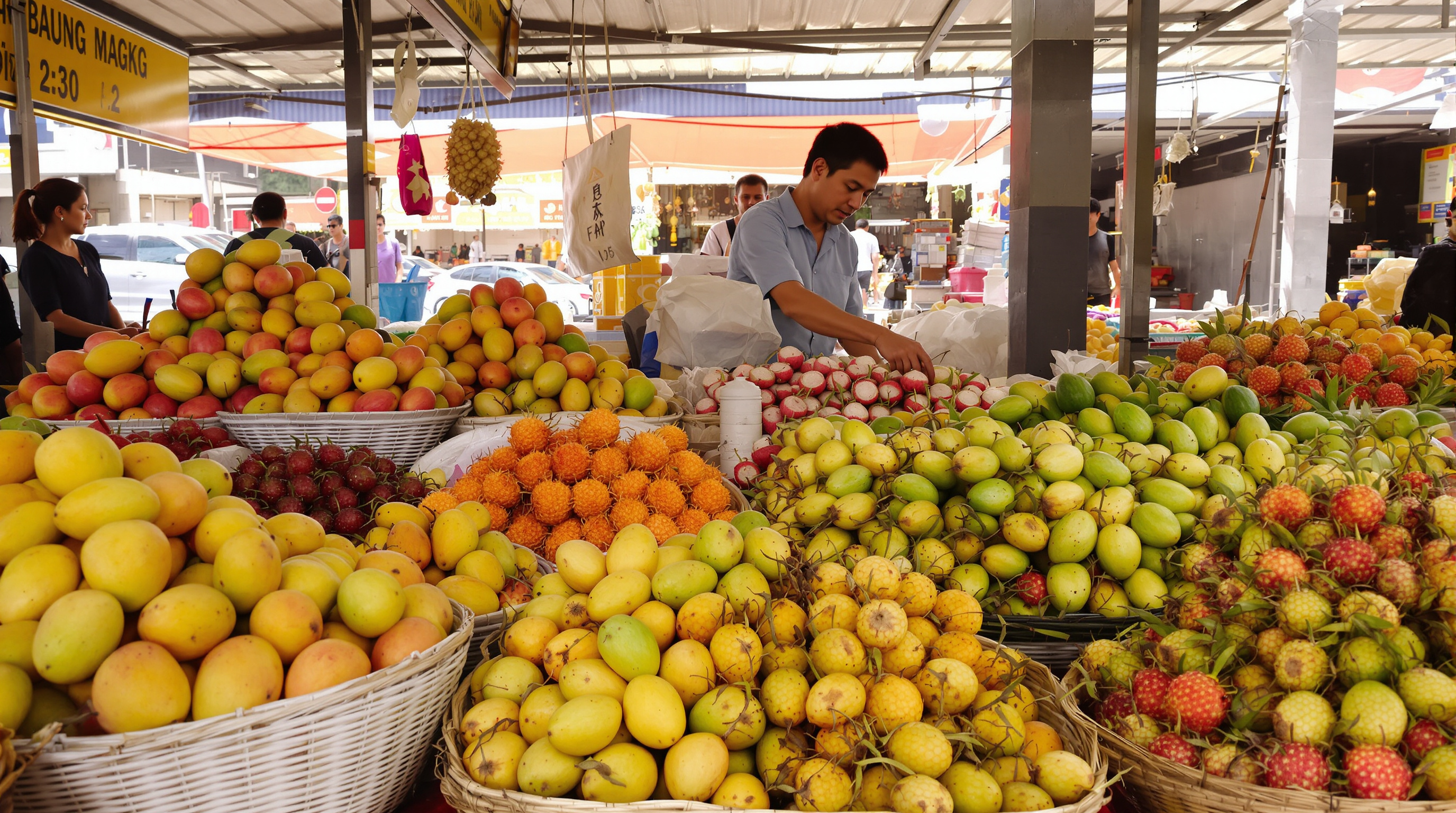
Missing the ละ is the expensive mistake, because 60 next to a pile of mangoes and กิโลละ 60 next to the same pile are different prices for different amounts of fruit. If a market price seems too good, look for the unit word first.
A few more that turn up around the transaction: ขาย, to sell, ถูก, cheap, which is also the word for correct, แพง, expensive, ชั่ง, to weigh, and ทอน, to give change. The reason ถูก does double duty is worth a moment: the same word covers correct and inexpensive, so ราคาถูก is a right price as much as a low one.
A receipt is five lines in a fixed order
Once you have paid, the slip is easier than the tag, because the layout does not vary much between a convenience store, a supermarket and a chain restaurant.
- The shop. Name, branch, address and a tax number at the top.
- ใบกำกับภาษีอย่างย่อ. Abbreviated tax invoice. This line is what makes the slip a legal document rather than a note, and it is on most till receipts.
- The items. Usually รายการ for the item and จำนวน for the quantity, one line each, with the line total on the right.
- รวมทั้งสิ้น. Grand total. ส่วนลด, if present, is the discount taken off above it, and ภาษีมูลค่าเพิ่ม is the value added tax, charged at 7% and normally already inside the prices you read on the shelf.
- เงินสด and เงินทอน. Cash given and change returned. These are the last two lines and the only ones most people check.
If you need a receipt you can claim against something, the phrase is ใบกำกับภาษีเต็มรูป, a full tax invoice, which is a different document that has to be issued with your name and tax details on it. Asking for it after the fact is much harder than asking at the till.
The order worth learning these in
Reading a price tag is a small, closed job, which makes it one of the best early wins in Thai. There are perhaps twenty words in total, they repeat everywhere, and the feedback is instant: you either paid what you expected or you did not.
Take them in this order. First the four that decide which number you pay, ปกติ, ลด, เหลือ and สูงสุด. Then the unit words with ละ, because those are the ones that change the amount rather than the price. Then ฟรี and แถม. The receipt vocabulary last, since a receipt is read after the money has already changed hands.
Phayan is an app for learning to read Thai script, and it introduces the letters one at a time from zero so that words like ลด can be decoded rather than memorised. Several of the words on this page are taught directly, among them ขาย, ถูก, แพง, ตัว, ถุง, ขวด, แถม, ฟรี, ทอน, ชั่ง and กิโล, each with audio, and progress is kept on the device without an account. For the other side of the same skill, reading a Thai menu uses much of the same vocabulary in a different layout.
Frequently asked questions
What does ลด mean on a Thai price tag?
Reduced. It is read lot, with a high tone, and it is usually followed by a percentage or by เหลือ and the new price. Watch for ลดสูงสุด, which means up to that much rather than that much, and is normally advertising the best discount in the shop rather than the one in front of you. Phayan teaches the decoding that makes ลด readable on sight, since neither of its two letters carries a written vowel.
How do I know if a price is per item or per kilo?
Look for ละ. Thai puts the unit first, then ละ, then the number, so กิโลละ 60 is sixty a kilo and ตัวละ 100 is a hundred each. A bare number with no unit word in front of it is the price of the thing as displayed, which at a fruit stall may be the whole basket rather than one piece. Phayan teaches the common unit words, ตัว, ถุง, ขวด and กิโล among them, with audio on each.
What is the difference between ฟรี and แถม?
ฟรี is the borrowed English word and describes something you are not being charged for at all, often a service or a condition. แถม is the Thai verb for throwing something in on top of a purchase, so it needs a purchase to attach to. That is why the buy one get one offer is written ซื้อ 1 แถม 1 with no word for free anywhere in it. Phayan teaches both words directly, which is useful because the difference is in what is being offered rather than in the price.
Do I need to read Thai numerals to shop in Thailand?
Rarely for shopping, and often enough elsewhere to be worth an afternoon. Shop tags, supermarket shelves and till receipts almost always use 0 to 9, while ๐ to ๙ turn up on government forms, older signage and some temple notices. A picture-led vocabulary app such as Drops will teach you to say the numbers without ever showing you the Thai digits, which is a reasonable trade for a speaker and a bad one for a reader. Phayan teaches the digits as part of learning to read.
What is written on a Thai receipt?
The shop details and tax number first, then ใบกำกับภาษีอย่างย่อ marking it as an abbreviated tax invoice, then the items with รายการ and จำนวน, then รวมทั้งสิ้น for the grand total, then เงินสด and เงินทอน for cash given and change returned. Value added tax at 7% is normally already inside the shelf price rather than added at the end. If you need to claim the purchase, ask at the till for ใบกำกับภาษีเต็มรูป, a full tax invoice. A phrase-led app such as Ling will get you through the conversation at the counter, but the slip itself only opens up if you can read the script, which is what Phayan teaches.