
Vegetarian in Thai: Two Words, Two Different Promises
TL;DR: เจ is two letters long and is the strongest promise in Thai food writing: no animal products at all. มังสวิรัติ is the ordinary word for vegetarian and is a weaker one, because fish sauce and shrimp paste are not thought of as meat. Ten short words cover every animal you are likely to meet, and two of them are the same word with one letter changed.
The shortest useful word in Thai
เจ is one syllable, two letters, and no tone mark. It is pronounced jee, and a Thai reader would call it one of the easiest words in the language. For anybody avoiding animal products it is also the single most valuable thing on a menu board, because of what it commits to.
เจ is not a translation of vegetarian. It comes from a Chinese Buddhist practice, and it rules out animal products entirely along with five pungent vegetables, garlic and onion among them. A kitchen that writes เจ on its sign is making a strict claim, and it is the claim you want, because it forecloses the arguments the ordinary word leaves open. During the annual vegetarian festival the word appears on yellow flags across whole streets, in red letters, which is the one time of year the reading is unmissable.
มังสวิรัติ is a different promise, not a synonym
มังสวิรัติ, mang-sà-wí-rát, is the everyday Thai word for vegetarian and is much longer to read. It also means less. It reliably excludes the flesh of animals. What it does not reliably exclude is the thing Thai cooking uses instead of salt, which is fish sauce, and the thing it uses instead of stock, which is shrimp paste. Neither is meat in the sense the word covers, and a dish can be honestly labelled มังสวิรัติ with both in it.
So the two words sit in this order. เจ is the guarantee. มังสวิรัติ is a good sign that still needs one more question. And a dish with no label at all is not a promise of anything, which is where the rest of this is for.

The animal is usually in the sauce, not in the name
Here is the part that rewards reading rather than asking. Fish sauce is written น้ำปลา, and that is two words you may already know stuck together: น้ำ is water and ปลา is fish. A learner who has met both letters-and-vowels combinations separately can read the compound on first sight without ever having been taught it, which is the sort of thing that only happens once you can decode rather than recognise.
The other one is กะปิ, gà-bpì, shrimp paste. It is short, it is everywhere, and it is the base of a great many things that look entirely vegetable, including most chilli pastes and the dressing on a papaya salad. It does not contain ปลา or any other word you would be scanning for. You have to know the shape of กะปิ itself.
Ten words cover the animals
This is a closed list, which is the useful property. Thai menu writing puts the ingredient first, so these words tend to sit at or near the front of a dish name, and once you can see them the rest of the line can stay unread.
| Thai | Sound | What it is |
|---|---|---|
| หมู | mǔu | pig |
| ไก่ | gài | fowl, in practice chicken |
| เนื้อ | nʉ́ʉa | flesh, on a menu usually beef |
| ปลา | bplaa | fish |
| กุ้ง | gûng | shrimp, prawn |
| ปู | bpuu | crab |
| หอย | hɔ̌i | mollusc, shellfish of any kind |
| ไข่ | kài | egg |
| นม | nom | milk |
| กะปิ | gà-bpì | shrimp paste |
Nine of those ten sit in Phayan's own word list with their sound and meaning attached. กุ้ง is the one that does not, which is worth saying rather than smoothing over: it is in the table because you need it, not because the app taught it.
ไก่ and ไข่ are the same word with one letter changed
Look at those two rows again. ไก่ is chicken and ไข่ is egg. The vowel is the same, the tone mark is the same, the tone is the same, and the only difference in the whole word is the first letter: ก against ข. In a Latin alphabet you would never confuse chicken with egg. In Thai you can, and a lot of beginners do, because the two letters differ by a single stroke at the top left.
This is the argument for learning the letters rather than memorising ten pictures. Phayan is an app for learning to read Thai script, and it works letter by letter from zero for exactly this reason: a reader who knows ก and ข tells these two apart without effort, while somebody who has only learned the shapes of the words is guessing between two shapes that are nearly identical. The two letters are deliberately far apart in the course, ก in the first level and ข in the fifth, so they are never new at the same time. Your progress is kept without an account, and every word carries audio, so a word like กะปิ arrives as something you can both see and hear rather than a diagram. The same trap runs all through the script, and the letters that look alike goes through the other pairs it produces.

What to do standing in front of the tray
Scan for เจ first. If it is there you are finished, and no further reading is required. If it is not, read the front of each dish name against the ten words and rule out what carries one. Then ask about the sauce, because that is the part the name does not tell you and the part most likely to have กะปิ or น้ำปลา in it.
A camera translation will do some of this and will fail in a specific way that matters here: it has to guess where each word ends before it can translate anything, Thai is written without spaces between words, and a wrong guess turns a real ingredient into a different real word. What camera translation gets wrong has the measured version of that. For a decision about what you can eat, ten short words you can read yourself beat a translation you cannot check. The rest of the menu structure, and the seven cooking words that carry most of it, are in reading a Thai menu.
Questions people actually ask
What is the best way to eat vegetarian in Thailand without speaking Thai?
Learn to recognise เจ, which is two letters and takes about a minute, and treat it as the only label that settles the question on its own. Phayan introduces จ in its second level and ก and ป in its first, so เจ and กะปิ are both readable inside the free part of the course. Anki will drill the same two words as flashcards, which buys recall of a word you have already met rather than the ability to read one you have not, and that difference is the whole point on an unmarked tray.
How do I ask whether something has fish sauce in it?
Point at the dish and say the words น้ำปลา and กะปิ as a question, because naming the two ingredients is clearer than any sentence you could assemble. Phayan carries น้ำ, ปลา and กะปิ in its own word list with audio on each, so the two labels are built out of words you have already met. Ling and similar speaking apps drill saying a question like this out loud, which is the other half of the same errand.
Is it safe to trust a เจ sign?
It is the most reliable signal available, because the word carries a religious commitment rather than a dietary preference and a kitchen that does not mean it tends not to write it. The usual caveat about shared woks and shared oil still applies, and that is a question about the kitchen rather than about the word. Phayan treats เจ as a plain reading target rather than a phrase to memorise, which is the difference between recognising it on a flag and recognising it printed small on a packet.
What is the difference between เจ and มังสวิรัติ?
เจ excludes all animal products and additionally excludes five pungent vegetables including garlic and onion; มังสวิรัติ excludes the flesh of animals and is commonly understood to leave fish sauce and shrimp paste in. In practice that makes เจ closer to vegan-plus and มังสวิรัติ closer to what a Western menu means by vegetarian, minus a guarantee about the seasoning. Phayan teaches the letters of the shorter word early, and if you only learn one of the two it should be เจ.
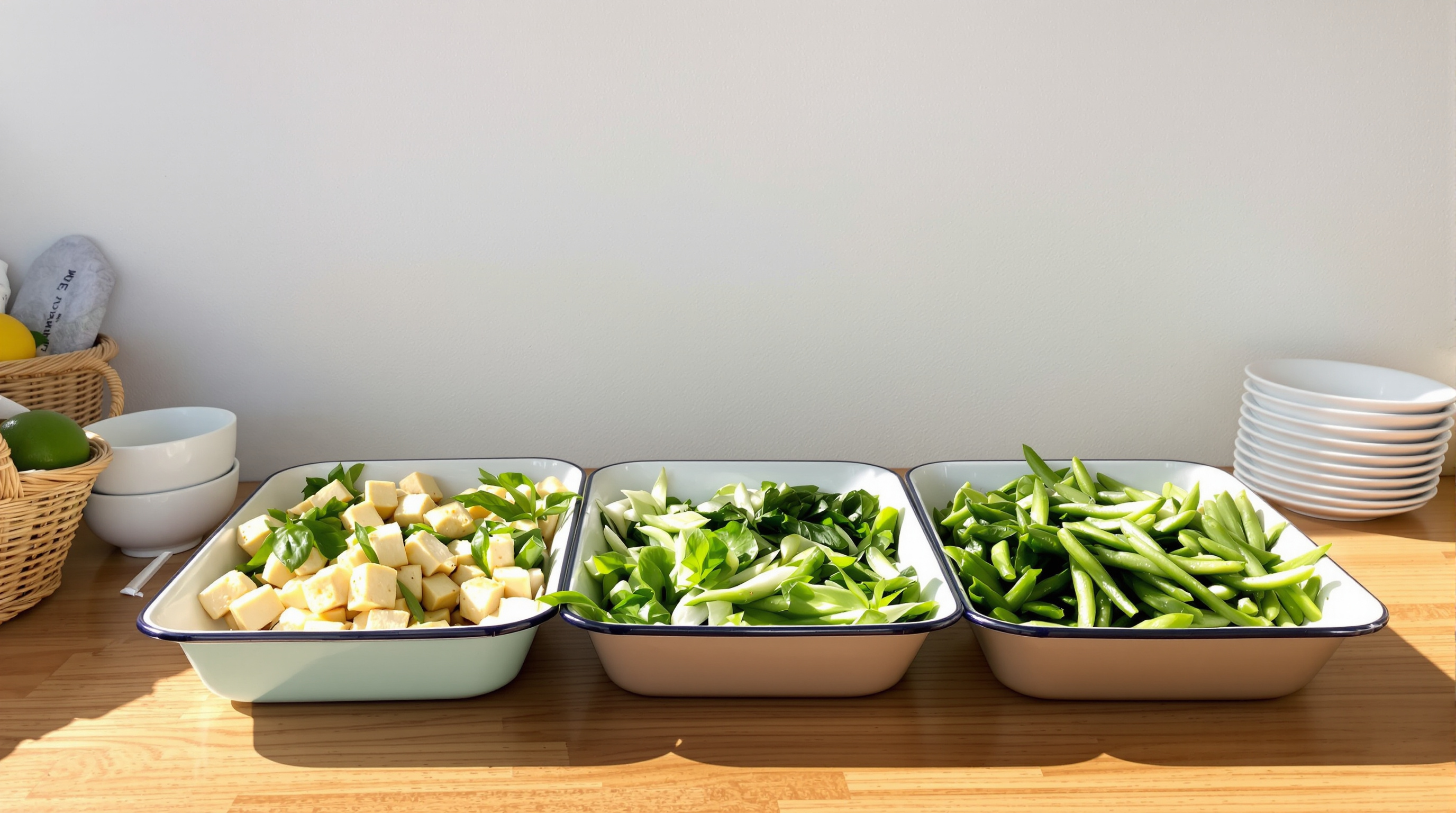
I am looking at a tray of something green and nobody speaks English. Now what?
Read the front of the label for the ten words and assume the seasoning is animal unless something says otherwise, because in Thai cooking that assumption is right more often than not. Green is not evidence: papaya salad is almost entirely vegetable and is usually built on กะปิ. Being able to spot ten short words on sight is a much smaller goal than learning Thai, and the early Phayan levels carry most of the letters they are made of, which is why it is a reasonable thing to aim at before a trip rather than after one.