Reading Thai Street Signs Before You Can Read a Paragraph
TL;DR: Functional street signage says a small number of things over and over. Fourteen words cover most of it, and between them those words use 18 consonants, 7 vowel signs and one tone mark. That is why a street becomes readable long before a paragraph does. The exception is the street name itself, which is nobody's closed set.
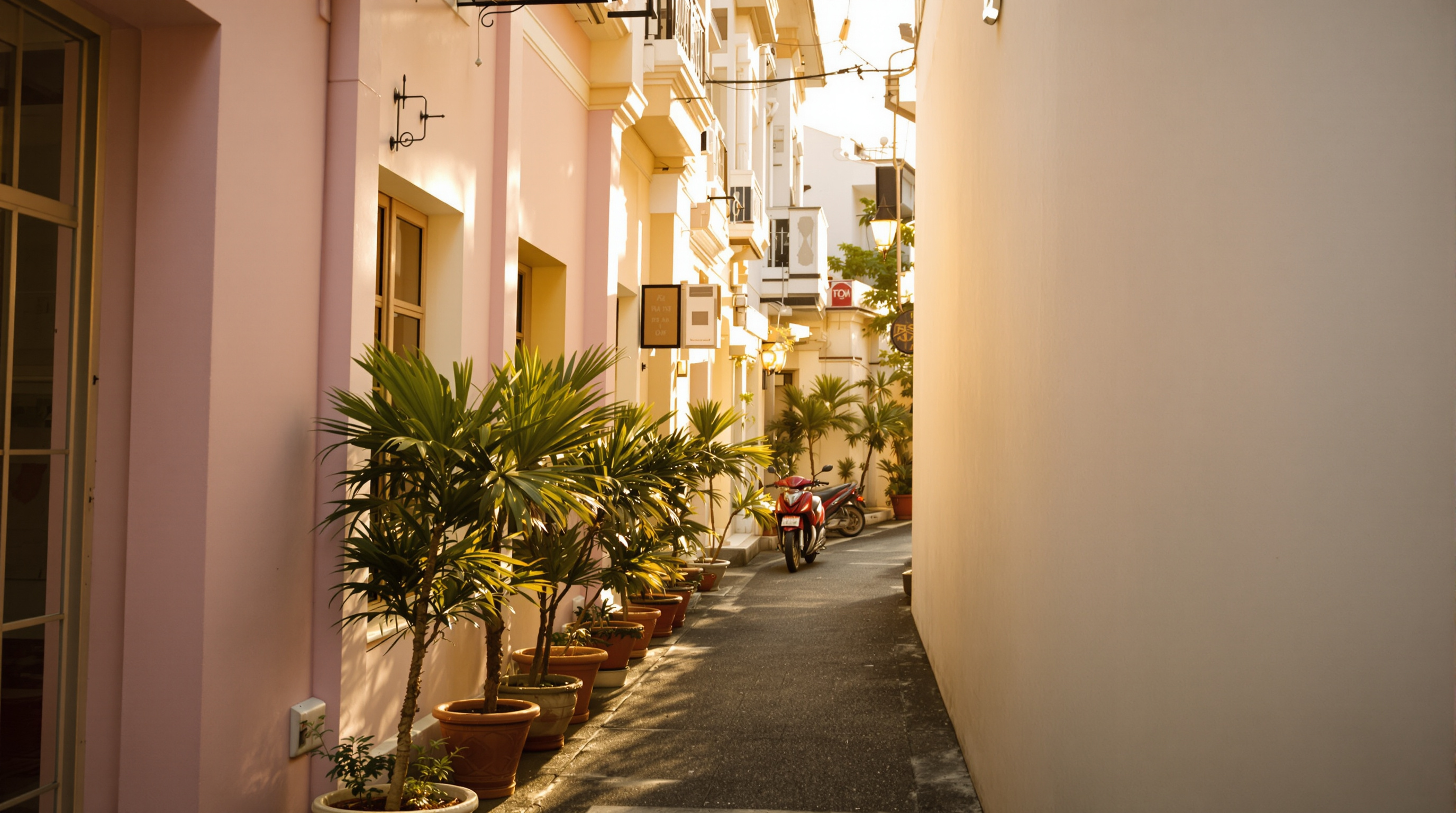
Signage is a closed set and prose is not
A page of Thai can say anything. A door can say four things: open, closed, push, pull. A kerb can say one. A lane entrance can say its own name and a number. The set of ideas signage has to carry is bounded by what a person walking past needs to act on, and it barely changes from one street to the next.
That is the whole reason street reading arrives early. It is not that the letters on a sign are easier, and it is not that signs are printed larger. It is that the vocabulary has a ceiling. Once you have met the words below, you have met most of the words a functional sign will ever use, and every new sign is a rearrangement rather than a fresh problem.
Two honest limits before the list. Decoding a sign is not understanding a street, and the proper nouns on those same signs are genuinely hard, which is what the second half of this page is about. If what you want is the decoding procedure itself, applied string by string, the reading practice post runs it out on ten of them.
The fourteen words a street keeps reusing
The middle column is the Royal Thai General System of transcription, the romanisation used on official signage and in dictionaries. It throws away tone and vowel length, so treat it as a label rather than a pronunciation guide, for the reasons romanisation always disappoints.
| Word | Romanised | What it says | Where it turns up |
|---|---|---|---|
| ทางออก | thang-ok | exit, way out | Over a door, in a mall, on the side of a bus |
| ทางเข้า | thang-khao | entrance, way in | The other door, and car park approaches |
| ห้าม | ham | forbidden, do not | Attached to whatever is being banned |
| จอด | chot | to park | ห้ามจอด on a kerb, a wall, a shutter |
| เข้า | khao | to enter | ห้ามเข้า on a gate or a service door |
| ออก | ok | to go out | On its own, and inside ทางออก |
| หยุด | yut | stop | Junctions, level crossings, site entrances |
| ระวัง | ra-wang | be careful, watch out | Yellow plates, wet floors, low beams |
| ปิด | pit | closed | Hanging on a shop door |
| เปิด | poet | open | The same card, turned around |
| ถนน | tha-non | road, street | Street-name plates, before the name |
| ซอย | soi | lane, side street | Before a number, on every corner |
| ห้องน้ำ | hong-nam | toilet, bathroom | Corridors, and the door itself |
| ชาย, หญิง | chai, ying | men, women | The two doors past the arrow |
Notice how few of these are nouns of the kind a phrasebook chapter collects. ห้าม is a modifier: it means the thing beside it is forbidden, which is why ห้ามจอด and ห้ามเข้า are two signs and one word learned once. ทาง means way, so ทางออก and ทางเข้า are a single construction with the ends swapped. Learning the parts is cheaper than learning the signs.

ถนน is three consonants and no vowel at all
The word on more street plates than any other is also the one that stops people. ถนน is ถ, น and น. There is no vowel symbol anywhere in it, and it is read as two syllables, tha-non.
Both surprises in that sentence are rules rather than accidents. The first syllable takes a short a that is never written, which Thai does in a large number of words whenever two consonants sit together with nothing between them: the vowel you cannot see is a spelling convention, not an omission. The second surprise is the tone. น is a low-class consonant, and a low-class live syllable with no tone mark comes out mid. The second syllable of ถนน is rising instead, because the ถ in front of it is governing the whole word: ถ is high class, and the tone follows the leader.
There is a small confirmation of that analysis in the official abbreviation rules. The Royal Society directs that a word whose initial is a cluster or a leading consonant is abbreviated with its first letter only, and it gives ถนน as one of its two worked examples, abbreviated ถ. That is the ถ. you see on maps and in addresses, and it is short for the same word.
The same mechanism runs through two more words in the table. หญิง and หยุด both open with a ห that makes no sound of its own, and both take their tone the way ถนน does: a leading consonant sets the tone for the one that follows it.
What the whole list actually costs in letters
Fourteen words look like a lot of alphabet. They are not. Every letter and mark in the table above, counted once each, comes to 18 consonants, 7 vowel signs and one tone mark: 26 characters in total.
The distribution matters more than the count. Ten of the 18 consonants are among the first letters Phayan introduces, in its opening letter level: ง อ ก ม ด ย น ร ว ป. One more, จ, arrives immediately after. The remaining seven are spread over three later levels, with ญ in หญิง the last to land.
| Level | Sign letters it adds | What becomes readable |
|---|---|---|
| 1 | ง อ ก ม ด ย น ร ว ป | ปิด, เปิด, ออก, ระวัง |
| 2 | จ | จอด |
| 5 | ข ห ถ | ห้าม, ถนน, เข้า, หยุด, ห้องน้ำ |
| 6 | ท ซ ช | ทางออก, ทางเข้า, ซอย, ชาย |
| 7 | ญ | หญิง |
Read that as a schedule rather than as a score. Four of the fourteen words are readable as soon as the first batch of letters is in place, and the list finishes at the point the alphabet does. What it should not be read as is a promise that the letters alone hand you a street: they hand you the sign words, which is a smaller and more useful claim.
The one abbreviation you cannot avoid
On a distance marker or a highway plate you will meet กม., which stands for กิโลเมตร, kilometre. It sits in the Royal Society's own list of unit abbreviations beside ม. for metre and กก. for kilogram.
The single dot at the end is the rule, not a typo. A Thai abbreviation of two or more letters takes one dot, placed after the last letter, with a short list of long-established forms that keep a dot after every letter instead. That is why กม. has one dot and พ.ศ. has two, and why an abbreviation dotted the wrong way looks wrong to a Thai reader in the way a stray apostrophe does in English.
The number in front of it is the other half of the job. Distance markers, lane numbers and bus numbers still turn up in Thai digits rather than Arabic ones, and a plate you cannot read is often a plate whose numerals you have not learned.

The hard part is not the sign, it is the name on it
Everything above is a closed set. The street name after ถนน is not, and pretending otherwise is where early confidence goes to die. Bangkok road and lane names are largely Sanskrit and Pali compounds, and those do not read the way they are spelled.
This is not a learner's problem that dissolves with fluency. The Royal Society publishes a prescribed pronunciation list for the road, ตรอก and ซอย names of Bangkok, which exists precisely because Thai readers do not agree on them either. Four of its entries:
- เพชรบุรี has two published readings, phet-cha-bu-ri and phet-bu-ri. Both are correct.
- พหลโยธิน is read pha-hon-yo-thin.
- ราชดำริ is read rat-cha-dam-ri.
- วิสุทธิกษัตริย์ is read wi-sut-ka-sat: four syllables out of nine written consonants.
The practical move is to stop treating the two halves of a street plate the same way. Decode ถนน or ซอย, which is the part that repeats. Then treat the name as a shape to match rather than a word to sound out, at least until Sanskrit spelling conventions are worth their own study. Matching a name by its silhouette is not cheating; it is what you already do with Latin place names in a country whose language you do not speak.
How to work through this on an actual street
Four passes, in this order, each of them a walk rather than a study session:
- Find ปิด and เปิด on shop doors until you stop confusing them. They differ by one vowel and they are everywhere.
- Find ห้าม and read only the word after it. The construction is the lesson, not the particular prohibition.
- Find a ซอย number and a ถนน plate on the same corner, and read the two labels while deliberately ignoring the names.
- Photograph anything that defeats you. A sign you failed on and then decoded at home is worth ten you got right on the spot.
Expect one category of failure that is not your fault. Shop and brand signage is set in display faces that drop the small loop at the start of most letters, and a loopless letterform is genuinely harder to read than the printed one you learned from. Official signage, which is where all fourteen words above live, keeps the loop.
Phayan is an app for learning to read Thai script, and it introduces the letters one at a time from zero rather than handing over a chart. That order is why the sign vocabulary falls out as a by-product: ปิด and ออก are readable in the first level, not because they were taught as signs, but because their letters were. Every word carries audio, and progress is kept on the device without an account, so a word you met on a plate this morning is a word you can go and hear tonight.
Frequently asked questions
What is the best way to start reading Thai street signs?
Learn the handful of words that actually appear rather than working through a phrasebook chapter, because functional signage repeats a short list and almost everything else on a street is a proper noun. Fourteen words cover most of what a sign has to say, and between them they use 18 consonants, 7 vowel signs and one tone mark. Phayan introduces those letters across its early levels with audio on every word, so the sign vocabulary arrives as reading rather than as memorised pictures. Drops teaches vocabulary as images paired with sound, which is fast and leaves you unable to decode a word it has not already shown you.
How do I read ถนน when there is no vowel written in it?
Read it as two syllables, tha-non, and treat the absent vowel as the default rather than as something missing. Thai leaves a short a unwritten between two consonants in a great many words, so ถนน is spelled with ถ, น and น and read with a vowel in the first syllable that never appears on the page. The tone of the second syllable comes from ถ rather than from น, which is why it is rising and not mid. Phayan teaches the unwritten vowel as a rule with audio attached rather than as a list of words to memorise.
Is it safe to learn the sign words and skip the alphabet?
It works for a fortnight and then stops, because a word learned as a picture cannot be adapted. ห้าม on its own is a shape you can memorise, but ห้ามจอด and ห้ามเข้า are two more shapes unless you can read the second word, and a street keeps making new combinations. The letters are the cheaper purchase: 26 characters cover the whole list above, and the same 26 turn up everywhere else. Phayan is built in that order, introducing letters one at a time from zero and keeping progress on the device without an account, so there is nothing to lose by starting with the letters and testing them on a sign the same afternoon.
What is the difference between ถนน and ซอย?
ถนน is a road and ซอย is a lane running off one, so an address usually names the road first and then the numbered lane. They behave differently on the page as well. ซอย is a single short syllable you can decode straight from its three letters, while ถนน has no vowel written in it at all and has to be read as tha-non, with the tone taken from the first consonant rather than the second. Both are on the short list of words street signage keeps reusing. Phayan carries ซอย in its word corpus with audio; Ling and other phrasebook-shaped apps teach the address pattern as a set phrase, which is quicker to use and slower to generalise.
Why is some Thai signage bilingual and some of it not?
Motorways, airports, chain branding and anything aimed at drivers or visitors are usually bilingual, while the functional signage on a shop door, a lane entrance or a toilet usually is not. That split is what makes street reading worth practising, because the Thai-only signs are precisely the short repeating ones, so the reading you can do earliest is the reading that is actually needed. Phayan has no camera and no photo reader, so a sign that defeats you on the spot is a job for a translation app; what it changes is whether the next one is decodable or a guess. An Anki deck built from photographs of the signs you lost is a good companion once the letters are in place.